Objective
The goal within this stage of the design thinking process is to understand the goals, needs, and frustrations of potential users. Before we come up with design solutions, it is crucial to know what college students and young adults actually struggle with, or even if they have any struggles at all.
Interviews
In total, my teammates and I interviewed 9 participants. Each interviewee was a seasoned college student, but their scheduling tool usage, workload, and major were all varied for maximum diversity in data. I interviewed Zaid, a junior in college studying economics and who uses scheduling tools very minimally; Hozshona, a senior in college studying psychology and relies on her scheduling tools heavily; and Lilly, a junior in college studying psychology and uses scheduling tools on a basic level.

Our team used prompt engineering with ChatGPT to help us generate questions that would be beneficial to ask our participants. In terms of prompt engineering, we gave ChatGPT context of the situation, what I want its role to be, what I want it to do for me, and how I want the information displayed. ChatGPT actually provided us with well-formatted questions, but there were a few issues that our team manually went through and fixed. For example, there were a couple of questions that were very similar and repetitive. We also reworded some questions to be less biased and gave room for the participant to provide us with design opportunities instead of just asking if they would like the idea of something. From our professor’s lecture slides, I understood that we were to be gathering information about our users’ behavior, goals, needs, opinions, and attitudes, so we organized our questions based on those categores An extra category titled social scheduling was included as well because one of the main features of our app was making it easier to consentually share schedules among others and AI. During the interviews, I also came up with a few new questions that I thought their answers would be useful to our research. For example, I wanted to learn about how each person handles big projects, what their sleep schedules look like, what they do in their small slots of free time between classes, and how long it usually takes for them to plan hangouts with their friends.
Interview Analysis
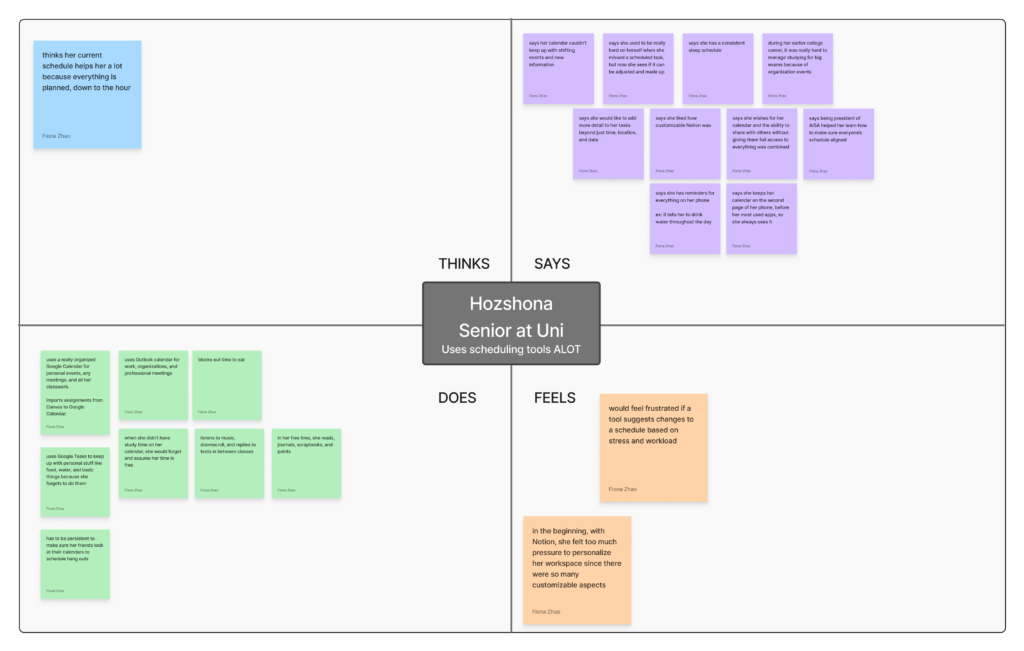
We gathered a lot of valuable information from each participant, but because of the high volume of information, we needed a way to sort quotes into four different boxes based on what each user said, thought, felt, and did through empathy maps (shown above). Using empathy maps helped us to start brainstorming design opportunities directly based on real-life users. For example, Hozshona said she wishes for her calendar and the ability to share with others without giving them full access to the details of each of her responsibilities. This response gave us the idea of giving users the option to hide the title of their task, but show that specific time is blocked out for something when sharing their schedules with friends and others.
Thematic analysis was another data sorting method that our team used. As a group, we shared our empathy maps and interview transcripts with ChatGPT and asked it to generate a few themes based on the responses that we received. This process allowed us to quickly view a summary of the common issues and thoughts among all 9 interviewees. The following are the themes that ChatGPT provided, with a few manual changes.
- Control VS Automation Tension
- Some users welcome the idea of a tool that suggests schedule changes, yet some like to be in control.
- Issues with Choosing or Remembering Important Tasks
- When users don’t have specific tasks with specific time slots blocked out, they struggle with keeping up with their large tasks.
- Lack of support for self-care with scheduling apps
- Users tend to have to manually prioritize their well-being since most scheduling apps do not consider personal wellness.
- Visual and UX Opinions
- Many users voiced their positive opinions on the importance of calendar color-coding, and some voiced their negative opinions on customizability with competitor apps.
- Reactive VS Proactive Time Management
- Some users have a hard time with procrastination, while others have grown out of the habit by scheduling specific times in their schedule to work on a project or study for exams.
- Social Coordination Issues
- Coordinating social activities relies on each individual’s willingness and timeliness in sharing their availability.
Challenges and Reflection
Because I have had experience with conducting interviews and interview analysis when designing a website for the OU VisComm program, there weren’t too many difficulties with completing those. This time around, there was more importance placed on the questions that we asked our participants, so it was a little challenging to word our questions in a way that would prompt the most useful responses. However, with this project, we are integrating artificial intelligence more, so ChatGPT helped us with the process of generating questions to ask our interviewees.
In this phase, I learned a lot about how to effectively use generative AI as a tool rather than a problem solver. Learning how to prompt engineer our commands to ChatGPT allowed the AI to provide us with well-rounded answers. Understanding that AI still frequently has issues with providing accurate information and biases, our team worked around those issues by validating any responses that ChatGPT provided and starting a new project folder within the website to ensure that the AI was not using previous knowledge that we gave it in earlier chats.