University of Oklahoma, School of Visual Arts
DES 3633: Integrated Tech, 2026
Mon & Wed (Section I: 9:30 – 12:20) & (Section II: 1:30 – 4:20 pm)
Location: Fred Jones Jr. Art Center Room. 111
Instructor: Raju Maharjan
Email: raju@ou.edu
Office Hours: By Appointment
Prerequisite: Majors only, DES 3633, DES 3663
Corequisite: DES 3653
This course is part of a research project funded by the Vice President for Research and Partnerships at the University of Oklahoma through the Initiative for the Humanities and Arts in Society Seed Grant Program.

Click here to learn more about the research project.
Course Description
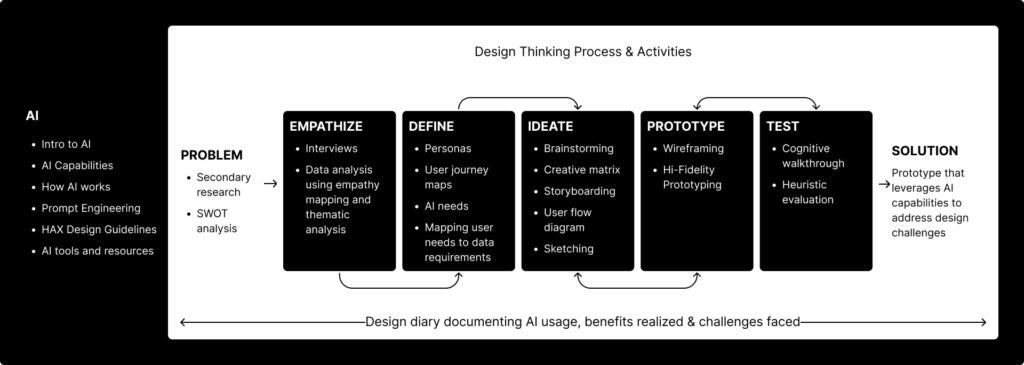
Adopting the design thinking process, in this course, students will address complex design challenges by using AI as both a creative tool and a design material. Through lectures, hands-on workshops, and team projects, students will explore AI capabilities and limitations and learn to apply AI to augment, transform, and challenge traditional design methods. By integrating AI into their projects, students will strengthen critical thinking and problem-solving skills while engaging with AI in both creative and critical ways.
Learning outcomes
By the end of this course, students will have:
- Use AI tools (e.g., ChatGPT, MidJourney, Figma AI) across the design thinking process.
- Analyze the impact of AI on design practices and identify challenges and opportunities.
- Design and evaluate AI-powered systems using a human-centered approach.
- Iteratively refine design solutions through user testing and evaluation.
- Give and receive constructive feedback to improve design solutions.
- Collaborate effectively within a team-based project.
- Communicate design processes and outcomes through presentations, reports, and online.
Texts & Materials
There are no mandatory textbooks for this class. All reading materials will be accessible through Canvas. Nevertheless, I strongly suggest considering the following resources:
Learning Activities
Learning activities will include lectures, discussions on assigned readings, individual and group design tasks, and presentations. The outcome of this course will be a design project that showcases your ability to apply human-centered design principles and exploration of AI’s role in key design processes, including requirements gathering, interaction design, prototyping, and the evaluation of an emerging technology solution.
As emerging designers preparing for professional career, you are encouraged to take ownership of your work. This involves cultivating independence, being proactive, and adopting a self-directed mindset. Please come to class prepared to engage. Bring questions, share your insights, and participate actively. The more you contribute, the more you will gain from the collective learning environment. Our classroom will serve as a collaborative space where learning happens not just through instruction but also through peer interaction and reflection.
Following diagram provides an overview of the learning activities in this course.
Assignments & Final Project
A significant portion of our class will focus on the final project, where teams of 2-3 students will use the design thinking process to design an AI-powered solution to address real-world problems. Topics must align with the course theme and require instructor approval. You will have both individual and group assignments, each contributing to the final project.
Assignment Deadlines & Extension Policy
Late submission will result in reduction of one letter grade. I am willing to grant extensions, but only if you contact me (in person or by email) before the date on which the assignment is due. At that time, you will set a new deadline for that assignment and will need to meet that second deadline to receive credit for that assignment. I will have the discretion to approve or reject that new deadline.
Assessment
Your final grade will be based on the following components:
- Assignments: 75%
- Midterm: 10%
- Final: 10%
- Class Participation: 5% (This is based on my subjective assessment of a student engagement during class. This includes actively participating in discussions, volunteering to share work, providing feedback on peers’ work, and using class time for course-related activities rather than unrelated tasks such as online chatting, shopping etc.)
Work will be graded according to the following scale:
- A (90–100%): Outstanding work that goes beyond expectations. Demonstrates strong understanding, creativity, attention to detail, and independent learning.
- B (80–89%): Good work that meets all core expectations. Clear, organized, and shows some originality and self-direction.
- C (70–79%): Satisfactory work that meets the minimum requirements. Shows basic understanding but may lack depth or polish.
- D (60–69%): Below average work with limited understanding. May be incomplete, rushed, or not fully aligned with assignment goals.
- F (0–59%): Work fails to meet basic requirements. Incomplete or shows little to no understanding of course concepts.
Attendance Policy
I understand that many of us may be faced with unforeseen circumstances that can prevent us from attending every session. If you miss class, you are expected to contact me. Any assignments that are due on the day you miss the class, would still need to be completed in accordance with our late work policy.
I will excuse absences due to accommodations, as communicated with ADRC, medical emergencies (including mental or physical, with a doctor’s, counselor’s, or ADRC note), illness or death in a close relation, and university sponsored activities. If you’re unsure whether your absence qualifies as excused, talk to me.
Attendance Impact on Final Grade:
- 1–2 absences (excused or unexcused): No penalty
- 3+ unexcused absences: Final grade lowered by one full letter
- 5+ absences: May result in a failing grade
Note: Two late arrivals count as one absence.
AI Policy
You are welcome to use generative AI tools in this course. However, where AI is used, you must include an AI usage statement that details:
- The AI tool(s) you used
- The prompt(s) you provided
- How the AI assisted you in meeting the assignment’s learning objectives
- What additional work you did to verify, edit, or build upon the AI-generated content to make it your own
Failure to provide this acknowledgment will be treated as a violation of the academic integrity policy.
Academic Integrity and Plagiarism
The goal of this course is YOUR learning. To demonstrate that, all work you submit must be your own. This includes writing in your own words, properly citing sources, and showing your own understanding of the material. If you’re unsure about academic integrity or plagiarism, ask. My goal is to create an environment where you can learn and grow, while also maintaining academic honesty and a clear representation of your learning. Penalties for serious offenses include a zero on the assignment and egregious offenses can even result in expulsion from the university.
Plagiarism as defined by the OU Integrity Office includes:
- Copying words and presenting them as your own writing.
- Copying words, even if you give the source, unless you also indicate that the copiewords are a direct quotation
- Copying words and then changing them a little, even if you give the source.
- Even if you express it in your own words, it is plagiarism to use someone else’s idea as your own.
Visit the OU Integrity Office for more information on what constitutes plagiarism.
University Policies
The University of Oklahoma has in place a number of policies intended to make the classroom a safe, nurturing environment. This class will adhere to all such requirements.
Mental Health Support
Support is available for any student experiencing mental health issues that are impacting their academic success. Students can either been seen at the University Counseling Center (UCC) located on the second floor of Goddard Health Center or receive 24/7/365 crisis support from a licensed mental health provider through TimelyCare. To schedule an appointment or receive more information about mental health resources at OU please call the UCC at 405-325-2911 or visit University Counseling Center. The UCC is located at 620 Elm Ave., Room 201, Norman, OK 73019.
Title IX Resources and Reporting Requirement
The University of Oklahoma faculty are committed to creating a safe learning environment for all members of our community, free from sex-based discrimination, including sexual harassment, domestic and dating violence, sexual assault, and stalking, in accordance with Title IX. There are resources available to those impacted, including: speaking with someone confidentially about your options, medical attention, counseling, reporting, academic support, and safety plans. If you have (or someone you know has) experienced any form of sex-based discrimination or violence and wish to speak with someone confidentially, please contact OU Advocates (available 24/7 at 405-615-0013) or University Counseling Center (M-F 8 a.m. to 5 p.m. at 405-325-2911).
Because the University of Oklahoma is committed to the safety of you and other students, and because of our Title IX obligations, I, as well as other faculty, Graduate Assistants, and Teaching Assistants, are mandatory reporters. This means that we are obligated to report sex-based violence that has been disclosed to us to the Institutional Equity Office. This means that we are obligated to report sex-based violence that has been disclosed to us to the Institutional Equity Office. This includes disclosures that occur in: class discussion, writing assignments, discussion boards, emails and during Student/Office Hours. You may also choose to report directly to the Institutional Equity Office. After a report is filed, the Title IX Coordinator will reach out to provide resources, support, and information and the reported information will remain private. For more information regarding the University’s Title IX Grievance procedures, reporting, or support measures, please visit Institutional Equity Office at 405-325-3546.
Reasonable Accommodation
The University of Oklahoma (OU) is committed to the goal of achieving equal educational opportunity and full educational participation for students with disabilities. If you have already established reasonable accommodations with the Accessibility and Disability Resource Center (ADRC), please log into iAdvise to request your semester accommodations as soon as possible and contact me privately, so that we have adequate time to arrange your approved academic accommodations.
If you have not yet established services through ADRC, but have a documented disability and require accommodations, please complete ADRC’s pre-registration form to begin the registration process. ADRC facilitates the interactive process that establishes reasonable accommodations for students at OU. For more information on ADRC registration procedures, please review their website. You may also contact them at (405)325-3852 or adrc@ou.edu, or visit www.ou.edu/adrc for more information.
Note: disabilities may include, but are not limited to, mental health, chronic health, physical, vision, hearing, learning and attention disabilities, pregnancy-related. ADRC can also support students experiencing temporary medical conditions.
Religious Observance
It is the policy of the University to excuse the absences of students that result from religious observances and to reschedule examinations and additional required classwork that may fall on religious holidays, without penalty. [See Faculty Handbook 3.15.2]
Adjustments for Pregnancy/Childbirth Related Issues
Should you need modifications or adjustments to your course requirements because of pregnancy or a pregnancy-related condition, please request modifications via the Institutional Equity Office website or call the Institutional Equity Office at 405/325-3546 as soon as possible. Also, see the Institutional Equity Office FAQ on Pregnant and Parenting Students’ Rights for answers to commonly asked questions.
Final Exam Preparation Period
Pre-finals week will be defined as the seven calendar days before the first day of finals. Faculty may cover new course material throughout this week. For specific provisions of the policy please refer to OU’s Final Exam Preparation Period policy.
Emergency Protocol
During an emergency, there are official university procedures that will maximize your safety.
Severe Weather: If you receive an OU Alert to seek refuge or hear a tornado siren that signals severe weather.
- Look for severe weather refuge location maps located inside most OU buildings near the entrances.
- Seek refuge inside a building. Do not leave one building to seek shelter in another building that you deem safer. If outside, get into the nearest building.
- Go to the building’s severe weather refuge location. If you do not know where that is, go to the lowest level possible and seek refuge in an innermost room. Avoid outside doors and windows.
- Get in, Get Down, Cover Up
- Wait for official notice to resume normal activities.
Additional Weather Safety Information is available through the Department of Campus Safety
The University of Oklahoma Active Threat Guidance
The University of Oklahoma embraces a Run, Hide, Fight strategy for active threats on campus. This strategy is well known, widely accepted, and proven to save lives. To receive emergency campus alerts, be sure to update your contact information and preferences in the account settings section at one.ou.edu.
RUN: Running away from the threat is usually the best option. If it is safe to run, run as far away from the threat as possible. Call 911 when you are in a safe location and let them know from which OU campus you’re calling from and location of active threat.
HIDE: If running is not practical, the next best option is to hide. Lock and barricade all doors; turn of all lights; turn down your phone’s volume; search for improvised weapons; hide behind solid objects and walls; and hide yourself completely and stay quiet. Remain in place until law enforcement arrives. Be patient and remain hidden.
FIGHT: If you are unable to run or hide, the last best option is to fight. Have one or more improvised weapons with you and be prepared to attack. Attack them when they are least expecting it and hit them where it hurts most: the face (specifically eyes, nose, and ears), the throat, the diaphragm (solar plexus), and the groin.
Please save OUPD’s contact information in your phone.
NORMAN campus: For non-emergencies call (405) 325-1717. For emergencies call (405) 325-1911 or dial 911.TULSA campus: For non-emergencies call (918) 660-3900. For emergencies call (918) 660-3333 or dial 911.
Fire Alarm/General Emergency
If you receive an OU Alert that there is danger inside or near the building, or the fire alarm inside the building activates:
- LEAVE the building. Do not use the elevators.
- KNOW at least two building exits
- ASSIST those that may need help
- PROCEED to the emergency assembly area
- ONCE safely outside, NOTIFY first responders of anyone that may still be inside building due to mobility issues.
- WAIT for official notice before attempting to re-enter the building.