
AIX Design: Prototype Lo-Fi & Test
When it came to the paper prototype, just how much did AI play a part?
Objective
The objective of creating and testing paper prototypes is to validate ideas early, quickly, and cost-effectively before committing to full development. During this stage of the design thinking process, we tested two users across three tasks to identify what worked well and what needed improvement. This approach allowed us to evaluate usability and design decisions without investing time in a high-fidelity Figma prototype. Ultimately, the goal is to reduce risk and refine the product by validating key assumptions before development begins.
AI Usage
When going through this phase, I had actually not used any AI. There were no generative AI tools used for any tasks design wise. At most ChatGPT was used to refine wording on reflection and descriptions. This included:
Can you refine this statement, please?
The objective of creating paper prototypes for an app and testing them is to validate ideas early, cheaply, and quickly before investing in full development. Approaching this stage of the design thinking process, we had tested two users with three tasks. We took this as a way to figure out what worked and what didn’t without having to make a whole Figma prototype. The goal is to test usability and validate design decisions early, reducing risk and improving the final product before development begins.
To which ChatGPT gave in response:
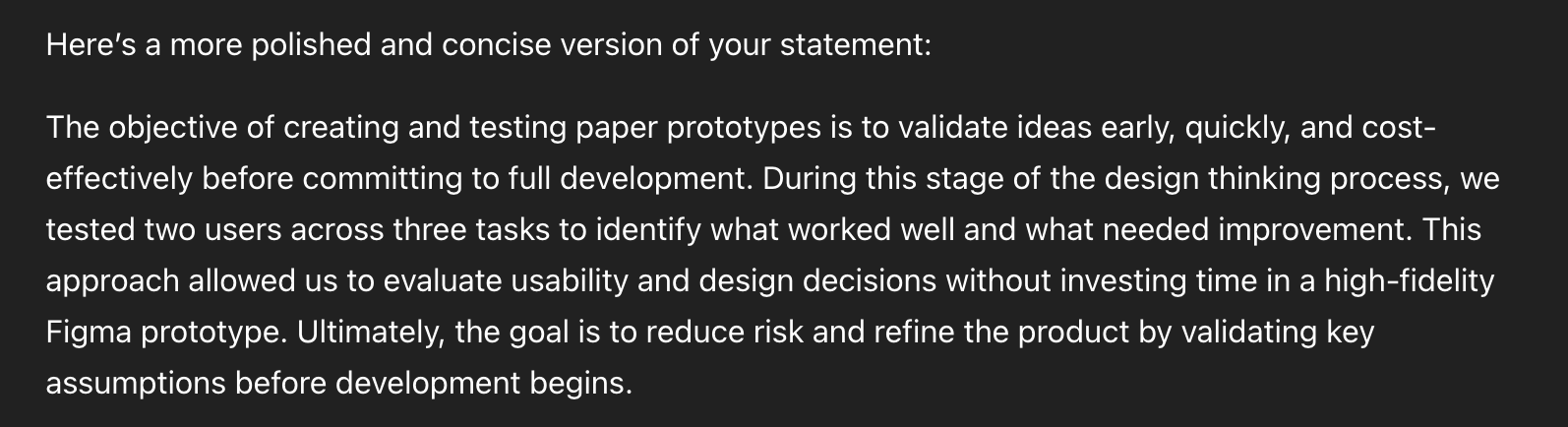
Which became my objective statement for this blog post.
Benefits and Challenges
I found myself when working through this round trying to think of how to use it, maybe for questions or how to phrase my tasks but even then I couldn’t even begin to think of a prompt. I had originally approached it to start to think of words that can be associated with the word “happy” to add to my example screen to explore a happy entry:
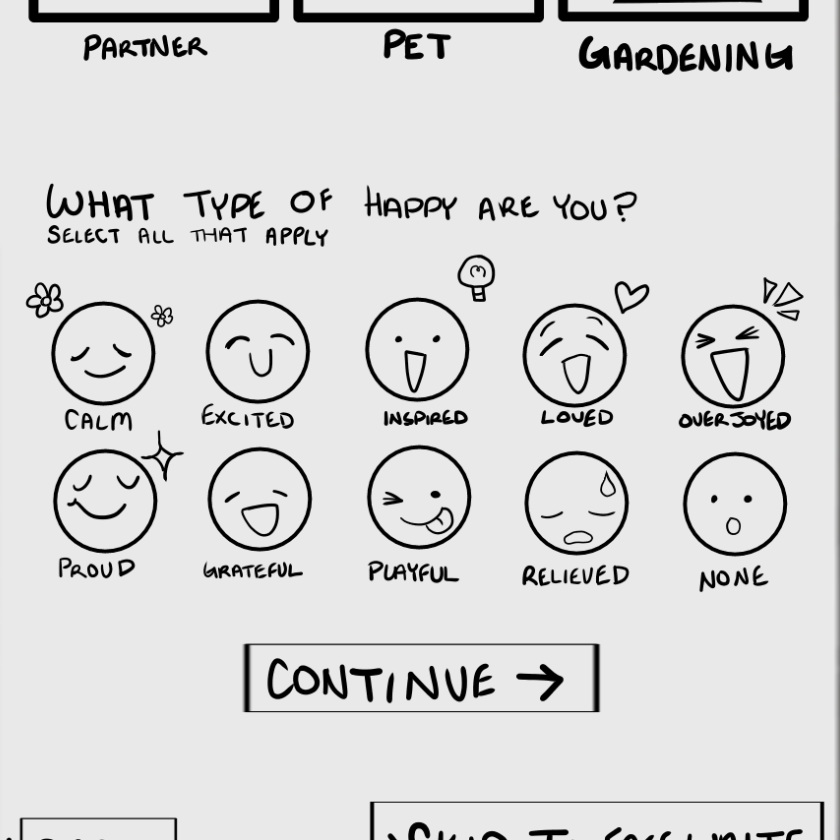
Yet, I just paused and went to a thesaurus, because I thought to myself, well, why wouldn’t I? That got rid of my initial need for the app. Then I thought of how to use it for my tasks, yet, this again was something that was so simple that I had decided against it. When trying to think of tasks I had written down what would be done and didn’t find myself struggling much, if anything only finding out once putting them in use what had been confusing to my tester versus what wasn’t.
While I’m sure there were plenty of benefits, I found myself struggling and finding it challenging to find uses for it over using it in general. For the tasks? Too simple. For the prototype? I already had ideas in mind and from my secondary research I had looked at other apps and what features and design aspects they had that I had gained inspiration from.
Reflection
It had actually become harder to find a reason to use AI. Every other aspect of this project so far had given me a reason, come up with intentional and thought provoking interview questions, using Figma’s sorting AI tools to group together our creative matrix, to sort them by the amount of stamps, using ChatGPT to create personas, user journey maps, word clouds, and all of these amazing results and yet I found myself coming to a blank in the end. I had found that my classmates were also working from their own thoughts, using hand drawn concepts, asking each other for advice as well as testing their apps with each other.
It showed that this phase was a bit different from the rest. Sure, before we had been a bit reliant on AI, using it to prompt so much of our work and I’m sure that some classmates may have a different experience, even sharing how they used AI. I had a weird disconnect from it like I hadn’t during this project. As this gets further into the design aspects I find myself being able to just throw myself into my work and get focused. It’s such an interesting mindset to find myself in.